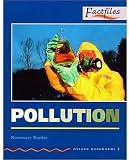
When you pollute something you make it dirty or dangerous. It is dangerous to drink polluted water or breathe polluted air; and if you pollute the ground, nothing will grow in it. Pollution can start in a small way - like using a river for waste. But then, pollution grows and grows, until everybody is in danger...Pollution is a book in the Factfiles series. Factfiles, as you may know, is a sub-series of Oxford Bookworms. Pollution is a Stage 2 book.
The book is divided into ten chapters. Each chapter consists of two pages, with the exception of Chapter 1, which is an introductory chapter of only one page. The ten chapters are: In the beginning; Polluting the air - coal; Polluting the air - oil; Acid rain; Water and chemicals; Recycling; Accidental or deliberate?; Radioactivity; Oil in the sea; and Change in the weather. These ten chapters are followed by a map and , as with other Factfiles books, some exercises and a glossary.
The language, as one woild expect with a Stage 2 book, is quite simple, the only difficult feature being the large number of proper nouns, unavoidable in a book introducing a city. Sentences temd to be quite short and simple. For example, the 11 sentences on page 4 have the following lengths (numbers of words): 17, 17, 10,16, 11, 4, 21, 22, 6, 14, and 18. This yields a mean of 14.45 words per sentence. The general pattern appears to be a short sentence followed by a longer one. Looking more closely at the longer sentences, we can see that many are composed of two independent clauses joined by the conjunctions "but" or "and". If we count these as separate sentences, we get a new mean sentence length of 9.43 words. To cut a long story short, it is unlikely That any students would be overwhelmed with the difficulty of this book.
The most interesting chapters for me were those with some connection with water, particularly Chapter 4 (Acid rain), Chapter 5 (Water and chemicals), Chapter 9 (Oil in the sea).
Polluted water kills more than 25 million people every year. One and a quarter billion people do not have clean, safe, water for drinking or washing.
(369/8068)